
Regular Price: $9.99
Today: $0.99
Deal Ends: Tue 17th March
Description:
Some ideas are forbidden not because they are false—but because they threaten the foundations of power.
In an age of expanding government, managed narratives, and pressure to conform to an evolving moral orthodoxy, the principles that once defined a free society are increasingly dismissed, distorted, or suppressed. The Forbidden Idea confronts this erosion by asking a deeper question than most political debates ever reach:
Do you believe in coercion, or do you believe in individual liberty?
A foreword by Dr. Ron Paul sets the tone. Drawing on political philosophy, natural law, economics, and history, Mark A. Monoscalco presents a rigorous yet accessible defense of individual liberty grounded in consent, moral agency, and voluntary cooperation. Rather than framing individual liberty as merely a policy preference or cultural slogan, this book argues that it is a moral necessity for any just society.
Unlike conventional political books that argue about what government should do, The Forbidden Idea examines whether government has the moral right to do it at all.
What makes this book different:
Most discussions of individual liberty stop at policy. This one begins with first principles.
The book compares individual liberty with its major philosophical rivals—central planning, collectivism, utilitarianism, and authority-based moral systems—and explains why societies built on coercion, even when well-intentioned, inevitably undermine both prosperity and human dignity.
This book invites readers to rethink what individual liberty actually requires and what is lost when it is compromised.
Inside, you’ll explore:
Why consent is the foundation of legitimate social order
How natural law and natural rights define the limits of political power
Why economic freedom is inseparable from moral and political liberty
How spontaneous order explains cooperation without central control
The cultural and psychological roots of collectivism and centralized authority
The moral case for individual responsibility over state authority
The Forbidden Idea is written for readers who are new to the philosophy and history of individual liberty. This book will also resonate with readers of The Law, The Road to Serfdom, and The Ethics of Liberty.
This is not a call to outrage. It is a call to clarity—about what individual liberty truly requires, what coercion destroys, and why the belief that human beings are not owned remains the most dangerous idea in politics.
If you are ready to understand individual liberty not as a slogan but as a coherent moral philosophy, The Forbidden Idea will permanently change how you see power, society, government, and yourself.
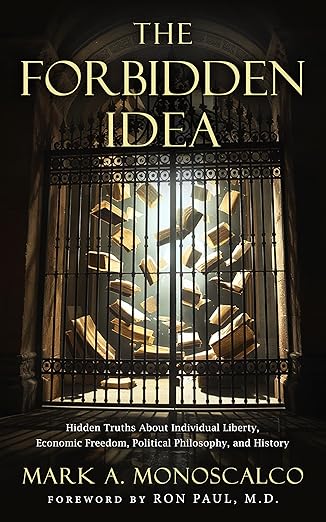
About the book cover:
Some words are closely related in meaning, such as light and enlightenment or darkness and ignorance. Darkness cannot resist light—it disappears when light is present. In the same way, ignorance cannot resist enlightenment; it fades when understanding is introduced.
From the perspective shown on the book cover, you stand outside the gates, surrounded by darkness—a symbol of ignorance. The elites of society want to keep you there, unaware of the ideas that could set you free. Behind the gates, the books glow with light, representing knowledge that brings enlightenment—The Forbidden Idea. To escape the darkness, read this book.
Read more
“Where is human nature so weak as in the bookstore?“
Henry Ward Beecher
More History, Politics & Culture here