
11 Contemporary Novels Where Nothing Really Happens (And That’s the Point)

I go to the beach most days. Same spot. I drop my backpack on a white rock, take off my shirt, wade in. Waist deep, I dive — surface on my back — and paddle slowly out to the count of 100. It’s far enough to be quiet and solitary, but not so far that […]

I go to the beach most days. Same spot. I drop my backpack on a white rock, take off my shirt, wade in. Waist deep, I dive — surface on my back — and paddle slowly out to the count of 100.

It’s far enough to be quiet and solitary, but not so far that I wonder what’s underneath me.

Some days I float there. Still water. Still mind. Everything else — the shore, the days, the rest of life — recedes. The moment stretches out, before and after everything.

That feeling — of observing something subtle change, of sensing a shift so small it barely counts as an event — is what first made me ask:

Could you write a novel that feels like this?

Could you describe the sea’s movements — its texture, its silence, its moods — as a kind of story? Could you create drama out of stillness?

Mezzanine cover

Mezzanine

By Nicholson Baker

In his startling, witty, and inexhaustibly inventive first novel first published in 1986 and now reissued as a Grove Press paperback the author of Vox and The Fermata uses a one-story escalator ride as the occasion for a dazzling reappraisal of everyday objects and rituals. From the humble milk carton to the act of tying one’s shoes, The Mezzanine at once defamiliarizes the familiar world and endows it with loopy and euphoric poetry. Nicholson Baker’s accounts of the ordinary become extraordinary through his sharp storytelling and his unconventional, conversational style. At first glance, The Mezzanine appears to be a book about nothing. In reality, it is a brilliant celebration of things, simultaneously demonstrating the value of reflection and the importance of everyday human human experiences.
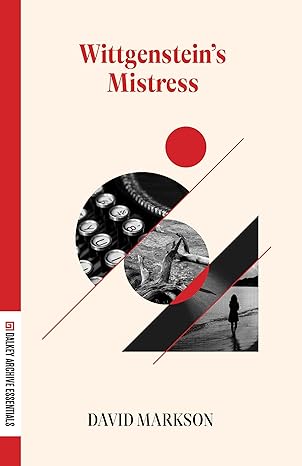
Wittgenstein's Mistress cover

Wittgenstein's Mistress

By David Markson

Wittgenstein's Mistress is a novel unlike anything David Markson or anyone else has ever written before. It is the story of a woman who is convinced and, astonishingly, will ultimately convince the reader as well that she is the only person left on earth. Presumably she is mad. And yet so appealing is her character, and so witty and seductive her narrative voice, that we will follow her hypnotically as she unloads the intellectual baggage of a lifetime in a series of irreverent meditations on everything and everybody from Brahms to sex to Heidegger to Helen of Troy. And as she contemplates aspects of the troubled past which have brought her to her present state―obviously a metaphor for ultimate loneliness―so too will her drama become one of the few certifiably original fictions of our time. “The novel I liked best this year,” said the Washington Times upon the book’s publication; “one dizzying, delightful, funny passage after another . . . Wittgenstein’s Mistress gives proof positive that the experimental novel can produce high, pure works of imagination.”

“Words are, of course, the most powerful drug used by mankind.“

Rudyard Kipling