Regular Price: $17.99
Today: $1.99
Deal Ends: Sun 29th March
Description:
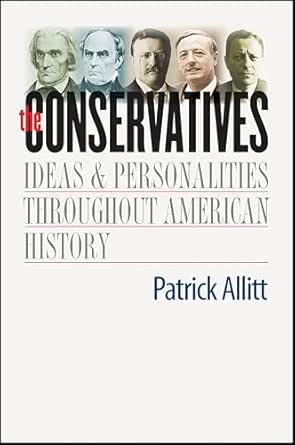
An even-handed, comprehensive assessment of conservative thought in America, from the Constitutional Convention to the present."A perceptive, rigorously balanced, and richly panoramic account of conservative ideas and thinkers in American politics and culture since 1787. This is a welcome indeed, necessary book." —George H. Nash, author of The Conservative Intellectual Movement in America Since 1945This lively book traces the development of American conservatism from Alexander Hamilton, John Adams, and Daniel Webster, through Abraham Lincoln, Teddy Roosevelt, and Herbert Hoover, to William F. Buckley, Jr., Ronald Reagan, and William Kristol. Conservatism has assumed a variety of forms, historian Patrick Allitt argues, because it has been chiefly reactive, responding to perceived threats and challenges at different moments in the nation's history.While few Americans described themselves as conservatives before the 1930s, certain groups, beginning with the Federalists in the 1790s, can reasonably be thought of in that way. The book discusses changing ideas about what ought to be conserved, and why. Conservatives sometimes favored but at other times opposed a strong central government, sometimes criticized free-market capitalism but at other times supported it. Some denigrated democracy while others championed it. Core elements, however, have connected thinkers in a specifically American conservative tradition, in particular a skepticism about human equality and fears for the survival of civilization. Allitt brings the story of that tradition to the end of the twentieth century, examining how conservatives rose to dominance during the Cold War. Throughout the book he offers original insights into the connections between the development of conservatism and the larger history of the nation."This is a spirited and scouring intellectual history, likely to become a minor classic. What is called 'conservative' is shown to be a uniquely American core of convictions repeatedly summon to hold the fort against waves of Europeanizing assailants." —Charles Hill, Hoover Institution, Stanford University"The book is every bit as fundamental for mavens of conservatism as Gottfried's primer on the post–World War II American Right, The Conservative Movement. . . . Both readers who expect to learn something and those who consider themselves well-versed about conservatism stand to be thrilled to meet figures and ideas new to them." —Booklist
“To learn to read is to light a fire; every syllable that is spelled out is a spark.“
Victor Hugo
More History, Politics & Culture here